

Miracles That Break the Walls of Illusion
Chotrul Duchen
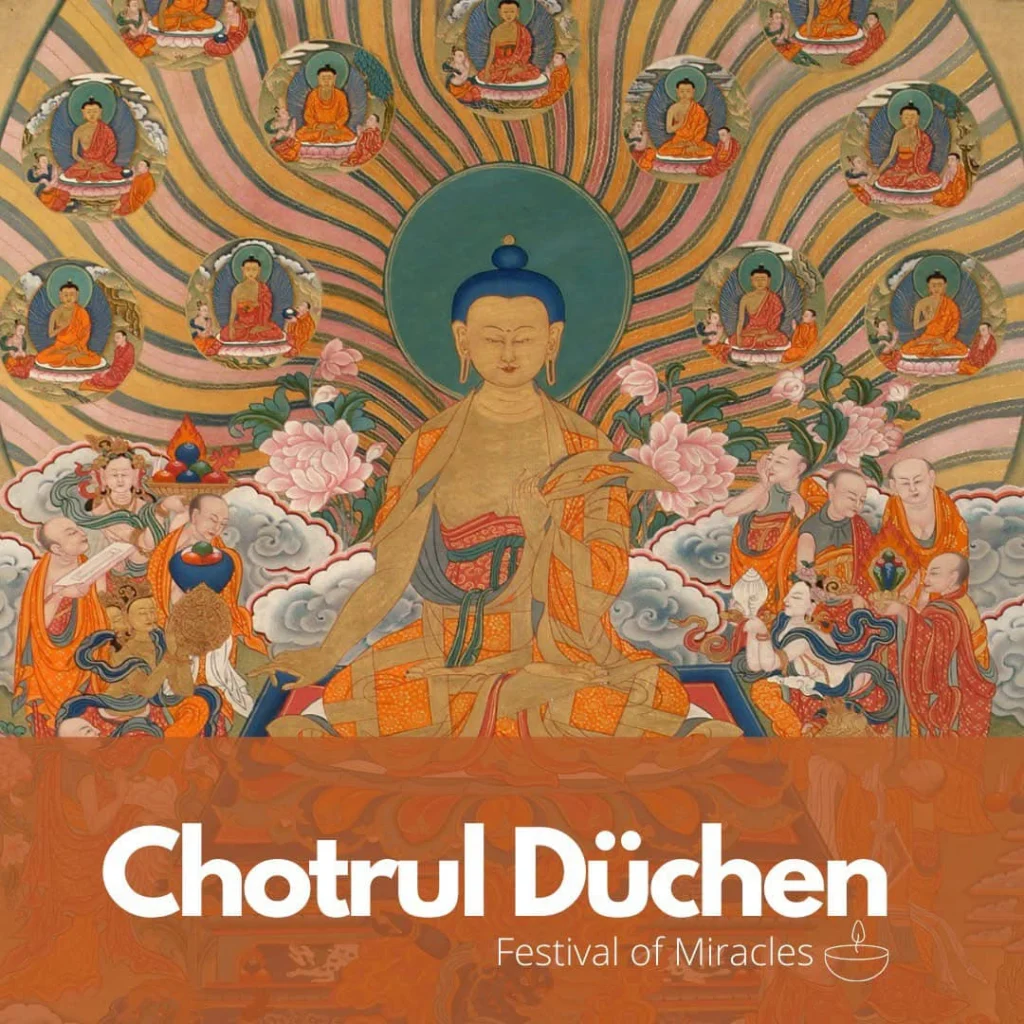
Student – Hi Lama la, 3 March is Chotrul Duchen. What actually is the meaning of this occasion and how should we best commemorate it.
Master – The day commemorates the culmination of a month in which the Buddha performed a miracle each day as way to defeat those hostile to the Dharma.
As practitioners striving to realize the truth, we may wonder how we should regard miracles. At first glance, they seem at odds with a path grounded in wisdom, one that actively discourages outward displays of accomplishment, since such displays can distract from the ultimate goal of awakening.
But, when awakened beings perform miracles, it is different. They are never done to show off, boost their ego, or attract sponsors, but to inspire faith and to shatter fixed ideas of reality.
In truth, we are like the frog in the well, who believed the water at the bottom of the well was the largest body of water in the world. Even when told of greater waters, he could not accept it. When finally taken to the ocean, he still could not believe his eyes — and, it is said, his head exploded.
We may consider ourselves open-minded and free-willed, but our views are similarly shaped and restricted by our life experiences. For example, could we, even in a dream, imagine a colour we have never seen or a flavour we have never tasted?
The aim of the Dharma is to break these narrow views and help us realize the fluid, interconnected nature of reality. It is like someone born inside a movie theatre, who has seen nothing but the scenes on the screen and believes them to be real. They fall in love with the characters, fear the villains, reacting with attachment, jealousy, anger, and aggression.
Then, one day, they are persuaded to leave the theatre. Suddenly, they realize that what they mistook for reality was only the temporary joining of factors — projector, light, screen, film, electricity — to which, based on their limited exposure, they had attached labels. From that moment, they are liberated. They can still enjoy the dramas, but they are no longer bound by what is nothing more than an illusion. Like a rainbow, they appear vividly before their eyes, yet under closer examination they are not truly there.
For us, the world itself is a theatre. It arises from the joining together of many factors, yet because we have experienced nothing else, we attach fixed labels and react as though we and the things we encounter are solid and permanent. Miracles can serve to disrupt this illusion, forcing us to question the apparent solidity of our world. They shatter the fixed views we cling to.
Consider four legs, a top, and a drawer. Most of us would call it a desk. But is it inherently one? A dog might see a bed. A child might imagine a doll’s house. Someone from the Amazon Jungle might see a boat. The concept of a desk is a creation of the mind shaped by experience. Like scenes in a movie, it exists conventionally, but under analysis, it dissolves.
Our practices are designed to dissolve the rigid views shaped by culture, education, and life experience. One approach begins with visualizing a deity statue with two arms — familiar and easy to accept. Then we encounter a thangka depicting a blue-skinned deity with four arms. Later, we work with images of deities bearing thousands of arms and an eye on the forehead. Gradually, the limitations of our conditioned perspectives fall away. Like someone realizing a movie is not real, we gain a measure of liberation.
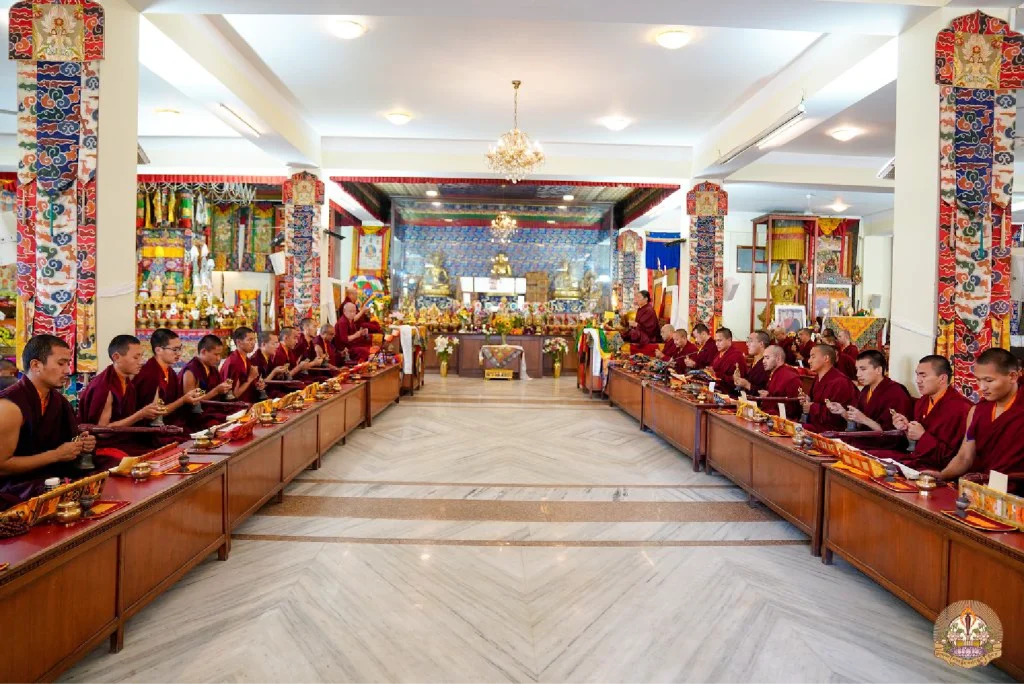
Stories of beings born from a lotus or riding a flying tigress serve the same purpose. But how we experience such events depends solely on our karma: those with fortunate or positive karma may be liberated instantly upon seeing a sacred image or witnessing a miracle. This sudden liberation is known as thongdrol — liberation through seeing.
Most of us, however, still need to create the causes and conditions for such images to break our rigid views. These causes and conditions are generated through merit. Merit itself does not produce liberation. Rather, since merit is rooted in a vow or sincere intention to benefit others, it counteracts the symptoms of mistaken view — desire, aggression, and pride — and gradually removes the obscurations that prevent us from recognizing our original nature. In this way, merit clears the path, enabling us to see things as they truly are.
Perhaps it is helpful to think of our original nature as the blue sky, often obscured by clouds. The clouds represent ignorance and mistaken views — the belief that the characters in the movie are real, or that a desk is ultimately a desk. Merit, when combined with wisdom, acts like a strong wind to blow away these clouds.
So, how best to commemorate Chotrul Duchen? While reflecting on the true nature of things, we should undertake meritorious deeds — such as offering a butter lamps.
However, since offerings symbolically express what we value and appreciate, they need not be limited to traditional forms. We can also be creative, offering something personally enjoyable, such as bubble tea, or even playing a favorite song by Snoop Dogg or Eminem, provided it is done with sincere and respectful intention. In essence, any action that counters negative emotions and draws us closer to recognizing the truth may be regarded as a meritorious deed.
Finally, as the effects of both positive and negative actions are multiplied millions of times on Chotrul Duchen, it is especially important to be mindful of our conduct on this day, creating merit while avoiding harming others.
However, since offerings symbolically express what we value and appreciate, they need not be limited to traditional forms. We can also be creative, offering something personally enjoyable, such as bubble tea, or even playing a favorite song by Snoop Dogg or Eminem, provided it is done with sincere and respectful intention. In essence, any action that counters negative emotions and draws us closer to recognizing the truth may be regarded as a meritorious deed.
Finally, as the effects of both positive and negative actions are multiplied millions of times on Chotrul Duchen, it is especially important to be mindful of our conduct on this day, creating merit while avoiding harming others.