About Bhutan
Home >
The land of Peaceful Dragon
Bhutan is a country in south-central Asia located on the Himalayan’s eastern slopes. Bhutan, which had previously been a distant kingdom, became less isolated in the second part of the 20th century, and the pace of change began to intensify. Bhutan is commonly known as the land of thunder dragon or peaceful dragon. Bhutan achieved international fame in the 1970s with Gross National Happiness, a broad measure of overall well-being that’s preferred more than the traditional statistic of gross domestic product, which only covers the production of goods and services, even those that make us unhappy.
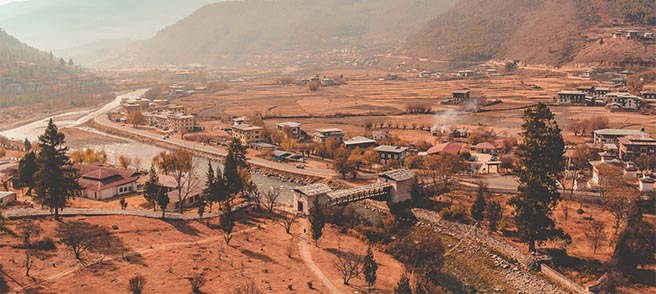
1. Bhutan Country
Bhutan is a tiny and secluded country nestled in the Himalayas between India and China, two of the world’s most powerful countries.
It has endeavored to bring in aspects of the outside world while fiercely maintaining its ancient customs, despite being almost completely blocked off for generations.
Bhutan’s name, Druk Yul, translates to “Land of the Thunder Dragon,” It was only in the 1970s that it began to open up to outsiders.
Since 1907, the Wangchuck hereditary monarchy has ruled.
However, following elections in March 2008, Bhutan became a two-party parliamentary democracy. Although Bhutan is a developing country, it has 65% of the land under forest cover, making Bhutan one of the two carbon-negative countries globally.
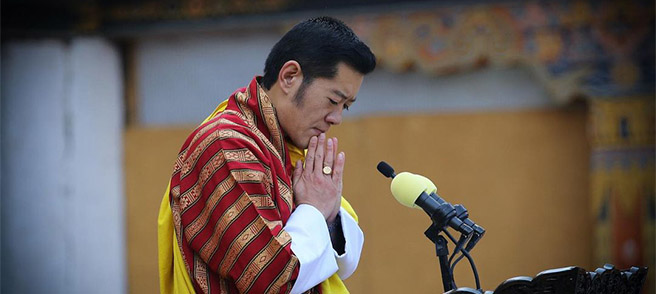
2. The King of Bhutan-Jigme Khesar Namgyel Wangchuck
After the Great Fourth King of Bhutan abdicated his throne on December 9, 2006, the current King of Bhutan became the monarch. In November 2008, an official public coronation ceremony was held. Bhutan celebrated its 100th year as a monarchy in 2008. He is the eldest son of Bhutan’s fourth king. He has three half-sisters and three half-brothers, as well as a younger sister and brother.
He completed the Foreign Service Programme and studied International Relations at Oxford University in the United Kingdom.
In Bhutan, polygamy is legal, and the previous King of Bhutan has four wives. Despite this, Bhutan’s current King has pledged not to follow in his father’s footsteps. King Jigme Khesar Namgyel Wangchuk is the people’s King and He is always there for the people of Bhutan especially when they need him the most.
His Majesty steers Bhutan out of danger as world reels in Covid-19
3. Language of Bhutan
Bhutan has a diverse linguistic landscape, with over nineteen dialects spoken. The Country’s natural setting, with its high mountain passes and deep valleys, is responsible for its linguistic diversity.
These physical factors required the Country’s residents to live in seclusion, but they also helped them survive.
Dzongkha, the native language of the Ngalops of Western Bhutan, is the national language of Bhutan. The language was initially spoken in the Dzongs; huge fortifications that serve as administrative hubs and monasteries.
The Tshanglakha and the Lhotshamkha are two more important languages. Tshanglakha is the native language of the Tshanglas in Eastern Bhutan, while Lhotshampa is the native language of the Nepalese in Southern Bhutan.
Khengkha and Bumthapkha are two different languages spoken by the Kheng Pas and Bumthap people of Central Bhutan. Mangdepkah, which Trongsa residents speak, and Cho Chang Nga Chang Kha, which Kurtoeps speak.
In southern Bhutan, the Sherpas, Lepchas, and Tamangs all speak their distinct languages.
4. Tourism in Bhutan
Bhutan tourism began in 1974 when the government of Bhutan opened its isolated Country to outsiders to raise cash and showcase Bhutanese distinct culture and traditions. The Kingdom of Bhutan, the Country of the peaceful dragon, received 287 tourists in 1974. The number of tourists visiting Bhutan increased considerably from 2,850 in 1992 to 7,158 in 1999. Tourism generated almost $2 million in annual earnings by the late 1980s.
Despite its openness to foreigners, the Bhutanese government is very conscious of the environmental damage tourists might have on Bhutan’s distinctive and almost untouched scenery and culture. As a result, we have had limited visitor activities from the beginning, preferring higher-quality tourism. This policy was initially referred to as “high value, low volume” tourism. In 2008, it was dubbed “high value, low impact,” which was “a small but substantial alteration.” While the small number of visitors ensures the low impact, it is not necessary to be wealthy to visit Bhutan but those that appreciate the value offered and know why they want to come to Bhutan are the ones who do.
During the peak season, a daily fee of US$ 250 per person per day is enforced, and a price of US$ 200 per person per day is applied during the low season – it is an all inclusive trip to Bhutan. Signaling that the administration was willing to accept more tourists while preserving “cultural and environmental” values. In 2005, a paper titled “Sustainable Tourism Development Strategy” put increased focus on growing tourist numbers by promoting Bhutan as an exotic niche destination appealing to conscious travelers using the country’s culture and environment.”
5. Bhutan Economy
Agriculture and forestry constitute the main source of income for more than 60% of Bhutan’s people, making it one of the world’s smallest and least developed countries. Subsistence farming and animal husbandry make up the majority of agriculture. Rugged mountains dominate the landscape, making road and other infrastructure construction difficult and costly. Bhutan’s economy is inextricably linked to India’s due to extensive commercial and monetary ties and reliance on Indian financial aid. Bhutan’s economy also depends on Bhutan tourism. The majority of industrial production is of the cottage industry variety. The majority of development projects, such as road construction, rely on migrant labor from India. Multilateral development organizations are assisting in the implementation of model education, social, and environmental projects.
The government’s desire to conserve the Country’s ecology and cultural traditions is reflected in each economic program. For example, the government encourages affluent, ecologically conscious travelers to visit due to its cautious expansion of the tourist sector. Foreign investment continues to be hampered by precise controls and ambiguous rules in sectors such as industrial licensing, trade, labor, and finance. Bhutan’s overall growth has been supported by hydropower exports to India, even though GDP declined due to the pandemic.
6. Bhutan GDP
Bhutan is a tiny and secluded country nestled in the Himalayas between India and China, two of the world’s most powerful countries. It has endeavored to bring in aspects of the outside world while fiercely maintaining its ancient customs, despite being almost completely blocked off for generations. Bhutan is one of the world’s smallest and least developed countries.
Bhutan economy is based on agriculture and forestry, which provide the main livelihood for more than 60% of the population. Bhutan’s economy is closely aligned with India’s through strong trade and monetary links and dependence on India’s financial assistance. Bhutan tourism is one of the main income sources of Bhutan.
If you enjoyed reading about Bhutan, find out why Bhutan is special. Click the link here: https://drukheritage.com/bhutan-the-secret-to-happiness/

7. Religion in Bhutan
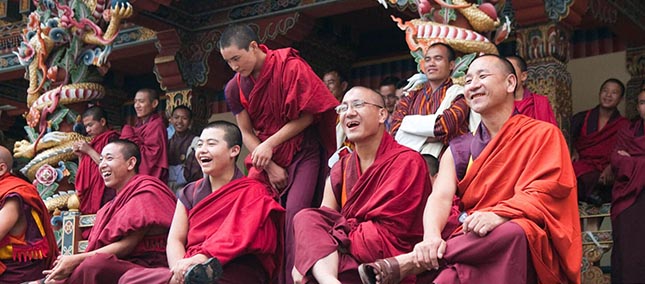
Bhutan’s official religion is Tibetan Buddhism, which is followed by 75% of the population. Bhutan’s constitution declares it to be a Buddhist country, and Buddhism plays a significant role in the country.Bhutan’s cultural legacy and people’s identity are both shaped by Buddhism. The King has promised religious freedom. The Drukpa Lineage of the Kagyu school, the Nyingma school of Tibetan Buddhism, or another school of Buddhism are followed by around 75% of the population of 770,000. Hinduism is practiced by nearly 23% (22.6%) of the population, mostly Lhotshampas.
8. Gross National Happiness
Gross National Happiness (GNH) is a holistic way to measure Bhutanese happiness and well-being. It is a tool for policymakers to use in order to enhance GNH.
GNH’S FOUR PILLARS:
- Good Governance, Sustainable Socio-economic Development, Preservation and Promotion of Culture, Environmental Conservation
- The four pillars are further divided into nine domains, which describe the many aspects of GNH in greater depth and serve as the foundation for GNH measurement, indices, and screening tools.
- THE NINE DOMAINS: Living standards, Education Health, Environment, Community, Vitality, Time-use, Psychological well-being, Good Governance, and Cultural resilience and promotion.
- These 9 categories show that, from the perspective of GNH, numerous interconnected factors have a role in establishing the conditions for Happiness.
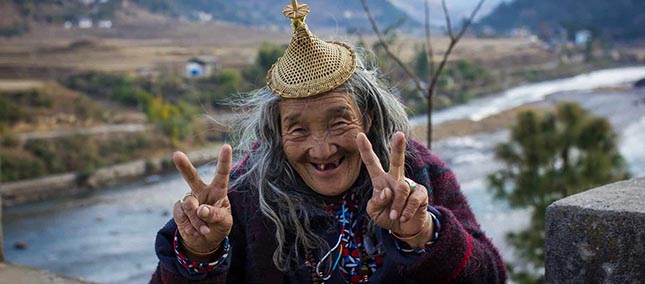
More joyful than gold
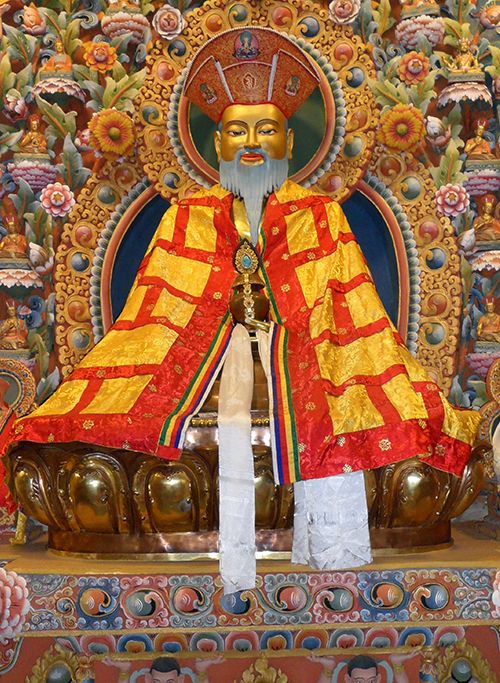
Zhabdrung Ngawang Namgyel – The unifier of Bhutan
‘If you are attached to small pleasures, you will not attain great happiness. Therefore, do not put this unceasing mind on other things; do not rest in shameless sleep; do not take joy in never ending prattle.’ These profound words of Zhabdrung Ngawang Namgyel (1594-1651) laid the foundation for an enduring legacy of wisdom.
Building upon this philosophy of detachment and mindfulness, Zhabdrung further counselled his followers, ‘Regard distractions, play and flattery of the young, one’s elders, and one’s friends as demons. If your mind has been turned by demons, you have no wish to study, to work, to perform recitations; you feel unhappy and you wonder if you have enough food and clothes. In that case, here is some kind but firm counsel; think; ‘Even if my heart rots and my body fall into hundred pieces, even though I am unhappy I must apply myself. Do that and you will reap your reward.’
Revered as the founder of Bhutan, Zhabdrung’s teachings balanced discipline with discernment in life and learning. He believed that one should approach life and learning with discernment. For instance, he preached: ‘If you are happy study, if not leave it; if you understand it study it, if it is difficult do not study it. If you are attracted stay; if not go. If it happens. Good; if not then that’s it. The stomach is satisfied, the clothes are warm.’ This balanced perspective, he taught, would not diminish one’s worth.
This nuanced approach to life and learning was just one facet of Zhabdrung Rinpoche’s multifaceted legacy. In the annals of Bhutanese history, few figures loom as large as this visionary and wise leader. He was not only a great statesman, outstanding general, talented artist, and extraordinary architect, but also a profound Buddhist teacher whose wisdom remains influential.
Good Qualities
Cultivating Virtues Zhabdrung Rinpoche’s teachings on personal development and spiritual growth, recorded in his seminal biography ‘Song of the Great Cloud of Dharma’ by Tsang Khenchen Penden Gyatsho (1610-84), are particularly illuminating. EmphasisSing the importance of perseverance and self-discipline, Zhabdrung Rinpoche said that virtues do not arise as an aside while you are enjoying yourself and taking pleasure in your darling children. They come by shouldering the burden of hardships while you still have freedom and independence.
Elaborating on this profound insight, Zhabdrung Rinpoche stated: ‘If good qualities arose incidentally, then because there is no-one who is not attracted to the wise and to happiness, everyone would be wise. Because that is not so, do you see how important perseverance and enthusiasm are? Look well! There is no greater advice than this, so keep it in mind. Read these words every day and keep their meaning with each movement of the mind. Have your own mind as a witness and do not be disappointed with yourself. You must be disciplined by yourself. Do this and you will quickly become wise. Therefore, please take this to heart.’
Around 1674, when Tsang Khenchen was in Bhutan, he wrote the biography. It is a 383-page and written in classical Tibetan. In 1975 Dr John Ardussi, widely regarded as one of the foremost scholars on Bhutanese historical studies from the United States, undertook the monumental task of translating it into English. He completed the translation of the first four volumes of , ‘The Song of the Great Cloud of Dharma,’ marking a significant milestone in making Bhutanese historical texts accessible to a wider, international audience.
Within this tapestry of Bhutanese historical and spiritual wisdom, we find the teachings of Zhabdrung Rinpoche, who elaborated on the level of determination required for success in both worldly and spiritual pursuits. He counselled: ‘Think well on this! Whatever works you do whether worldly or religious, of importance or not, begin at the beginning and having started, be certain that you can carry it through. If you are not sure that you can do it, do not regret but leave it. That is best because once you have started it is not right to give up.’
Power of Commitment
Expanding on this principle of commitment Zhabdrung Rinpoche advised that once committed to a task, one must see it through to completion, regardless of circumstances. Using a common metaphor, he said that even if lightning strikes, the earth quakes, or there are world-ending collisions; whether you encounter personal perils such as your head catching fire or venomous snakes slithering onto your lap; or whether you experience fluctuations in your schedule, hunger levels, or emotional state—none of these factors should deter you from your goal. Whatever challenges arise, you must persist.
Zhabdrung Rinpoche further elaborated on the consequences of abandoning one’s commitments, stating, ‘If you begin but then give up, you will be embarrassed in front of your friends, your relations, even those you dislike. You will make your teachers, your elders, your friends, everyone, whether close or distant, very unhappy. Would that be right?’ This powerful statement underscores the importance of follow-through for personal growth, reputation, and relationships, highlighting the broader social impact of our commitments.
Building upon this theme, Zhabdrung Rinpoche cautions against distractions that can derail our commitments: ‘Time wasting meaningless activities, mental distractions, visual distractions, enjoyments, leisure activities, laughter; do these things have any meaning? Think: Knowing that I have certain qualities, how will they ever improve in this situation? Forcibly remind yourself of this every day.’
You discipline yourself; you look to your own faults. Likewise, constantly ask yourself; ‘One month has passed; have I done my recitations? Have I memorized the scriptures? Am I more capable? Am I any wiser? If the answer is yes, then rejoice. If the answer is no, you should hang your head and consider that such a person as yourself, no matter what religious or worldly tasks he undertakes does not rank among human beings. And you should make some strong resolutions.’ This guidance emphasizes the importance of self-reflection, discipline, and focused effort in personal growth.
Zhabdrung Rinpoche asserts that true knowledge and wisdom require diligent effort, not just natural talent. He poetically states, ‘Learning is sorrowful when studying, but when learned is more joyful than jewels and gold,’ challenging the notion of easily acquired wisdom.
‘Also; The wise suffered when they were learning; if you understand this, your joy will be greater than gold and jewels.’ And; ‘Having developed perseverance you should apply it.’ This vivid imagery reinforces the idea that true achievement and happiness come through hard work and perseverance.
As Zhabdrung’s close disciple, Tsang Khenchen possessed unique insights into the great master’s life and teachings. This privileged perspective, coupled with his scholarly acumen, resulted in a biography of unparalleled authenticity and depth.
The preservation and dissemination of Zhabdrung Rinpoche’s teachings have been further enhanced by unexpected contributions from diverse sources. One such example is the ‘History of Ladakh’ by Tashi Rabgias (1927-2020). This text captures Zhabdrung’s speech where he cites powerful metaphors to illustrate the value of perseverance. For example, Zhabdrung says, ‘A person who lacks perseverance is like the dust.’ He further elaborates, quoting Lama Guma: ‘Wear the hat of straw on your head, the clothes of straw on your body. Keep your hands dirty; do not avoid mental suffering. If you do not work hard, you will not find sweet food. If you do not know the taste of suffering, you will not know the taste of happiness. The hands that wish for food need iron tongs.’
The significance of this text extends beyond its original context, reaching far corners of the world through unexpected channels. A serendipitous encounter between Rabgias and Steve Berry, a mountaineer and a long time well-wisher of Bhutan, brought this wisdom to light in a new setting. Recognizing the profound nature of Zhabdrung’s words, Berry had portions of the text translated and even incorporated an extract into his 1988 wedding ceremony in the United Kingdom, where it was recited by his Best Man. This cross-cultural exchange exemplifies how ancient wisdom can find new relevance and appreciation across time and borders.
These translations from classical Tibetan to English serve a vital role in preserving and disseminating Zhabdrung Rinpoche’s teachings. By bridging linguistic and cultural divides, they ensure that Zhabdrung’s profound insights continue to resonate with and inspire diverse audiences across generations. The fact that these teachings found their way into personal milestones, such as Berry’s wedding, underscores their enduring relevance and universal appeal.
Conclusion
The wisdom of Zhabdrung Ngawang Namgyel, though centuries old, remains remarkably relevant in today’s world. His emphasis on commitment, perseverance, self-discipline, and the pursuit of wisdom offers a timeless guide for personal and professional growth. As we navigate the complexities of modern life, Zhabdrung’s teachings on commitment and persistent effort provide a timeless framework for personal and spiritual development, challenging us to apply these principles in our own pursuits and to remember that the joy of personal growth and achievement is indeed ‘greater than gold and jewels.’