
Empathy
Status is Shaky, Empathy Endures
Student – Hi Lama la, I am 19 years old and facing a dilemma. My parents, who are wealthy through inherited land and property, have always treated me well — sending me to good schools and providing for my needs. Yet there is a habit of theirs I find increasingly difficult to accept. Whenever we attend Buddhist teachings or rituals, they march straight to the front to claim the best seats, showing little regard for the local villagers who sit on the hard ground, exposed to sun or rain. I could accept this if their status came from serving the nation or if they were invited guests, but they are not. Their sense of entitlement stems solely from wealth, and this makes me deeply uncomfortable. I have tried sitting with the villagers myself, but my parents became angry, saying it would embarrass them. Another point of conflict is my wish to work in a café or restaurant to save money for traveling in India and Nepal. My mother strongly opposes this, insisting it would be shameful for her educated son to take such work. This leaves me wondering: Why do people let status rob them of the freedom to live as they wish, and erode their empathy and the dignity of labour? And what can I do to influence my parents’ attitudes?
Master – Wealth has long been intertwined with privilege. This is why people flaunt chunky diamond rings, drape themselves in 24-karat gold, carry designer handbags, and drive luxury cars. Many of these possessions are gaudy, impractical, or burdensome to maintain, but none of this matters. Their value lies not in elegance, but in the social message they project.
Of course, every mundane action aims at happiness and relief from discomfort, so the question arises: does this habit help them achieve these goals? In some respects, perhaps it does, at least temporarily. Like your parents, they may secure better seats at rituals or receive faster service at offices, as others assume they have influential connections.
Yet all of this comes at a heavy price: empathy is diminished, stress intensifies, and freedom is lost. Why is this? Well, empathy diminishes when status is pursued for personal gain rather than for the benefit of others, narrowing our concern to ourselves and weakening our capacity to care for those around us.
Stress arises because status and wealth — the foundations of privilege — are artificial constructs, defined only by shifting points of comparison. Just as a person may seem tall among shorter people but short among taller ones, status and wealth exist only in relation to unstable surroundings. To rely on them for security is like sitting on a wobbly chair: instead of providing support, they foster insecurity, breeding stress and an endless search for more props to hold us up.
We surrender our freedom when we shape our lives by the values of others.
In contrast, compassion arises from our timeless, unconstructed basic goodness — our Buddha nature. Unlike wealth or status, it is inexhaustible and not dependent on changing circumstances or other values.
Indeed, the Buddha’s own path to awakening was ignited by empathy. In the Jataka Tales, which recount his past lives, he consistently chose compassion over self-interest: offering his body to feed a starving tigress, sacrificing his comfort to aid others, and practicing patience in the face of cruelty. Such acts of selflessness arose from a profound commitment to alleviate suffering, undertaken without thought of personal gain or recognition.
Through countless lifetimes of compassionate deeds, he accumulated the spiritual perfections (paramitas) that culminated in his enlightenment as the Buddha. His journey shows that liberation does not arise from wealth or status, constructs that shift with time and circumstance, but from the inexhaustible wellspring of empathy and compassion, expressions of our innate Buddha nature.
In this light, it seems contradictory to be indifferent to the discomfort and well-being of others during a Buddhist ceremony intended to cultivate the very causes and conditions that lead toward the same awakening realized by the Buddha.
Why, then, do some people act this way? Mostly out of habit. Maybe, their parents or friends behaved similarly, and over time they stopped noticing the villagers’ hardships as they sat exposed to sun and rain. The villagers, for their part, have long accepted this role and are unlikely to think much of it.
As the villagers’ children attain higher levels of education, however, these social dynamics will inevitably shift. We can only hope that your parents and others begin to show greater concern for the less privileged, allowing change to unfold peacefully. After all, we depend on one another, sharing the rewards of a harmonious society and bearing the burdens of a fractured one.
In truth, the idea that the wealthy should use their status to help build a harmonious society by caring for the poor rather than exploiting their position for personal benefit, is not mine; it comes from the Buddha himself. In the Dīghajānu (Vyagghapajja) Sutta, he teaches: “With wealth rightly gained, people should support their families, friends, and those in need by performing acts of generosity. In this way they create a circle of social harmony and affection.”
Similarly, drawing once more on the Jataka tales, the Buddha recalls a former life in which he was born into a prosperous household and gained renown for generously sharing his wealth. Whenever villagers suffered from famine, illness, or misfortune, he gave freely, ensuring that no one was left destitute. His generosity was balanced and sustainable, enabling him to continue supporting others over time.
The Buddha explained that true wealth lies not in accumulation but by letting go of the self and easing the suffering of others. By sharing with the poor, he cultivated respect, trust, and lasting harmony within his community.
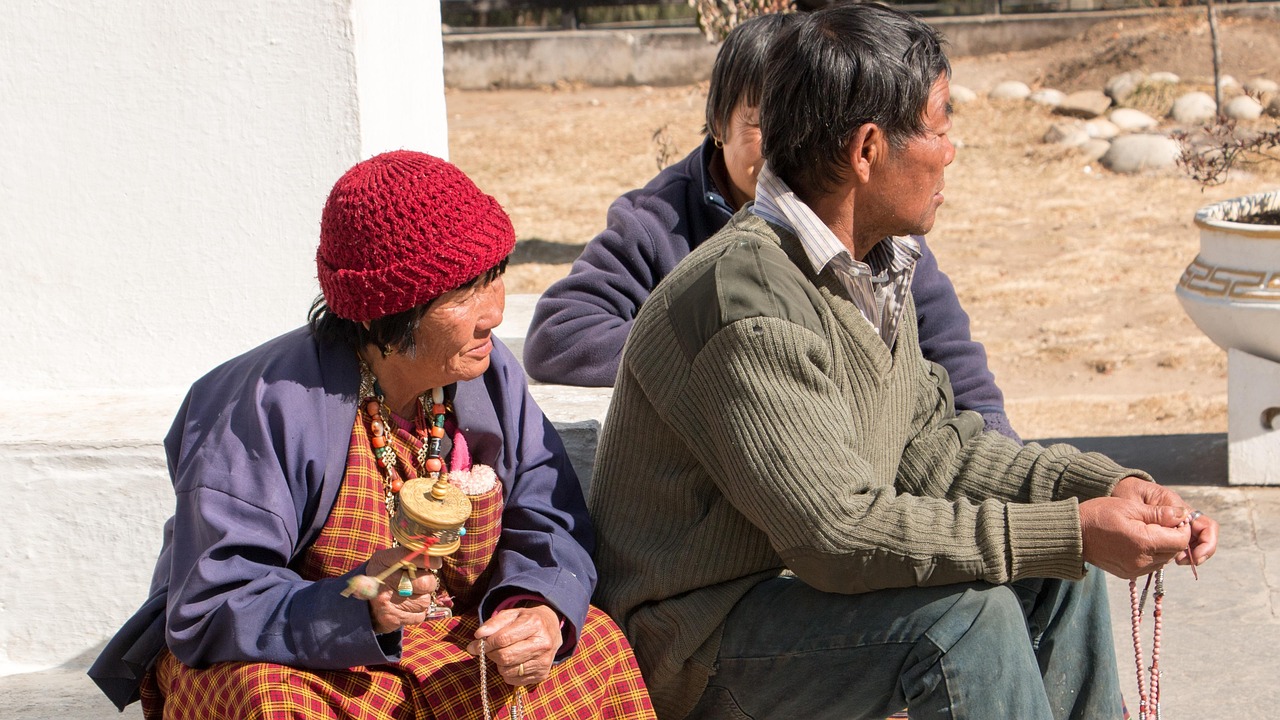
As for your parents, it may help if you explain your views more clearly. As I said, their behaviour likely stems from long-standing habit rather than harshness or indifference. If you gently draw their attention to the discomfort that the villagers — especially the elderly — endure in the heat and rain, it will likely stir empathy. In truth, it would be hard for anyone with a heart to feel otherwise.
While it may be too great a leap for them to trade shaded seats for the exposed ground, they can at least begin to shift their attitude by acknowledging the villagers with simple gestures of humility — a sympathetic nod or a kind word in passing.
Such recognition may inspire further acts of kindness, including sponsoring drinking water or providing tarpaulin shelters. In reality, Bhutanese people are widely known for their hospitality, community spirit, and generosity, and numerous patrons already engage in such altruistic deeds.
Regarding café work, your wish to earn your own travel expenses is admirable. Overindulged children often grow spoiled and struggle to function in the real world, causing many to turn to drugs or alcohol. You have avoided that path; instead, you show remarkable maturity and empathy for your age.
Personally, I believe that rather than feeling ashamed, your parents should be proud of your character and support your ideas. Of course, I’m not familiar with your family dynamics, so I cannot say exactly how you should address their concerns. Still, if you express your views with calm, patience, and consistency — and perhaps enlist the help of a sympathetic relative, a trusted aunt or uncle, for instance — there’s a good chance your parents will come to appreciate your perspective.
Ultimately, humility and empathy are not signs of weakness or inferiority but the highest virtues born of true self-confidence, reflecting our innate goodness, our Buddha nature.