
Why the Buddha Points to the Moon, Not the Gods
Student – Hi Lama la, I have a simple question. My brother recently pointed out that I often use the word “god” in everyday expressions like “Thank god you’re well” or “Oh my god” when I’m surprised. He said he finds it annoying and even offensive, especially from a Buddhist perspective, since Buddhism doesn’t accept the concept of a creator god. He suggested I avoid using such phrases altogether. When I thought about it, I explained that, to me, “god” is just a way of referring to figures like the Buddha or Guru Rinpoche. But he insists that in Buddhism, they are not considered gods in any sense. Now I’m confused, and so could you please clarify some points: As a Buddhist, is it inappropriate to use the word “god” in casual conversation as I do? Are the Buddha and Guru Rinpoche ever regarded as divine beings in Buddhist teachings – if not gods, then what are they? Finally, is it true that Buddhism doesn’t recognize the existence of creator gods? Thank you la.
Master – In English, phrases like “Thank god” or “Oh, my god” are widely used and have become part of everyday speech, irrespective of a person’s actual beliefs. These expressions tend to be emotional or habitual, rather than deliberate statements of faith. Seen in that light, their use is harmless and not intended to promote any particular belief system.
Personally, I think it’s important not to overanalyze every word people use in casual conversation. If we look too closely, we’d find that many everyday expressions have roots in religious ideas. Even the word “goodbye” comes from the phrase “god be with you” — a simple reminder of how deeply such references are woven into the fabric of language.
Sometimes, we could all benefit from taking a chill pill and focusing on someone’s intention, rather than interpreting their words and actions through our own cultural filters and personal prejudices.
However, your attempt to explain your usage by linking it to figures like the Buddha or Guru Rinpoche may have unintentionally added confusion to the issue. In that respect, your brother’s point does carry some weight.
From a Buddhist point of view, the idea of an eternal creator god doesn’t make sense. A being is only called a creator after creating something — just like someone is only called an artist after producing a painting. This means the god must have had a beginning – a time when he became a god – and anything that has a beginning, because it arises from causes and conditions, ultimately lacks true existence and will come to an end.
In this way, Buddhism not only denies that the universe or world was created by a supreme being, but moreover refutes the idea of a permanent creator god altogether.
You ask, what then was the Buddha? Was he not an eternal divine being? The term “Buddha” comes from the Sanskrit root “budh”, which means ‘to awaken’. So, “Buddha” literally means “the awakened one”. What did he awaken to? He awoke to the truth, specifically the reality that all compounded things are impermanent, all emotions are painful, all phenomena are empty of inherent existence, and Nirvana is beyond extremes.
As for the historical Buddha, like all sentient beings, he was subject to the laws of impermanence. His being arose from the coming together of various components — organs, flesh, bones, sensations, mental processes — and, as such, was finite. This was made evident by his passing and cremation at Kushinagar.
However, what we refer to as Buddha nature — his awakened mind, which we all possess — is not a physical form but a quality of pure awareness. It is often likened to the sky: vast, formless, and ever-present. Though obscured by clouds (our afflictions and ignorance), the sky itself remains untouched and unchanged.
This is why the awakened mind is regarded as permanent — not because it is a static, fixed entity with a divine status, but because it is not created; it is uncovered. As Chogyam Trungpa Rinpoche expressed, “Enlightenment is permanent because we have not produced it; we have merely discovered it.” Buddhist practice, then, is not about manufacturing enlightenment, but about dissolving the obscurations that conceal it — like clearing clouds that momentarily veil the sky, or washing away the mud that obstruct a gem’s innate brilliance.
The cloud analogy works well to illustrate the Buddhist path: we don’t create the sky’s openness — we uncover it by removing obscuring clouds. In some approaches, the focus is on gradually clearing these obscurations through sustained practice. In others, the path begins by recognizing the pristine, ever-present sky from the very beginning and deepening our familiarity with that view.
In either case, the state of awakening is not something constructed or fabricated — it is not a conditioned experience — and for that reason, it is considered to be permanent.
In Buddhism, gods are recognized — but not in the way theistic traditions conceive them. The deva (god) realm is one of the six realms of samsaric existence. Beings are reborn into this realm as a result of positive karma, but like all conditioned phenomena, this realm is impermanent. When the karma that sustains it is exhausted, it ends, and rebirth in another realm follows.
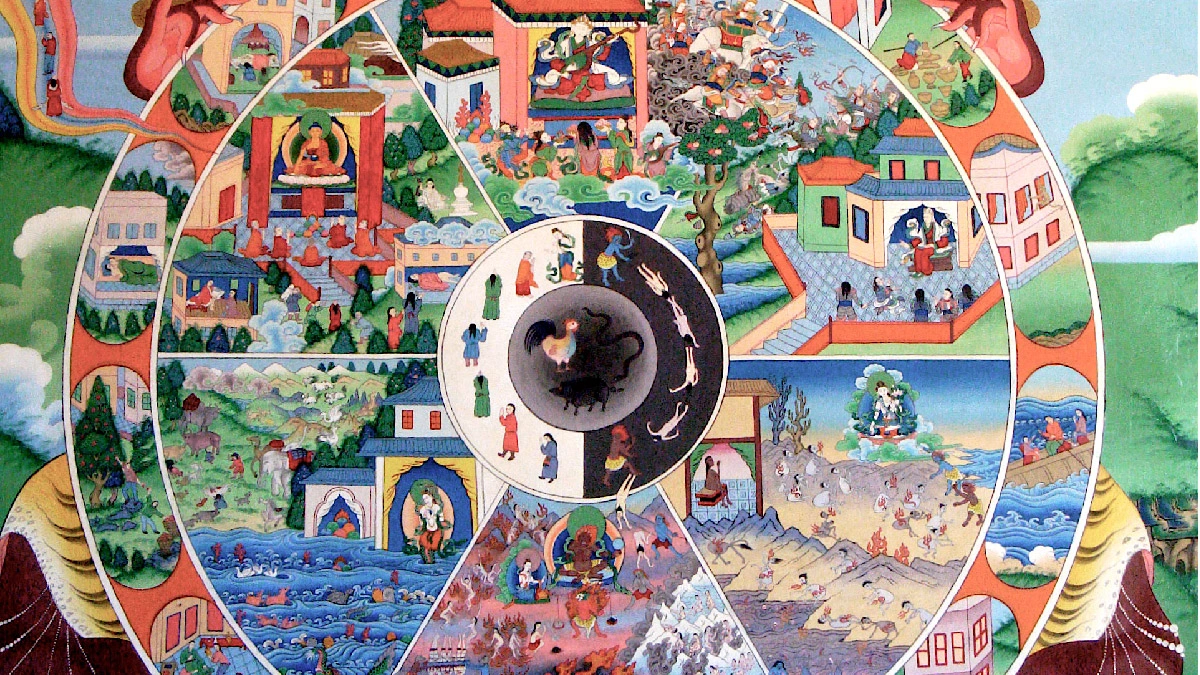
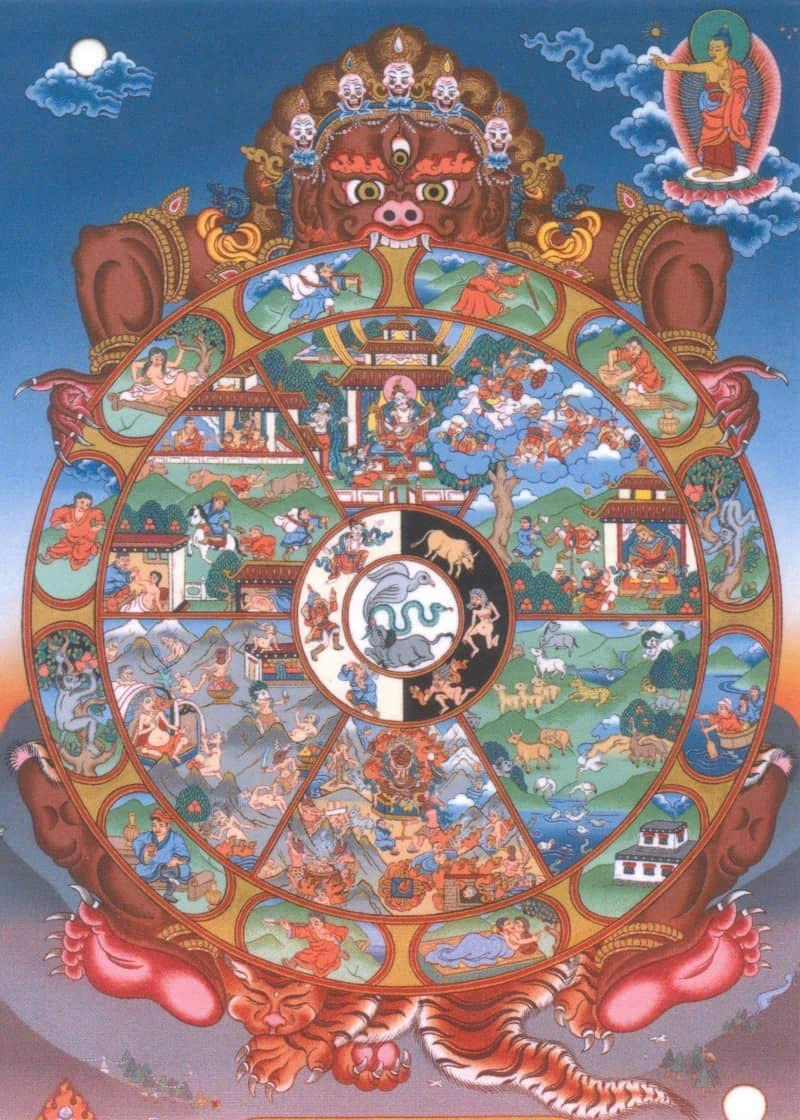
Although the god realm may offer immense pleasure and power, its impermanent nature places it firmly within samsara, the cycle of birth and death. As such, it is not the ultimate aim of Buddhist practice. This is clearly illustrated in the ‘Wheel of Life’ (Bhavachakra), a traditional painting often displayed at the entrance of lhakhangs. The six realms — including the god realm — are clearly depicted within the wheel, symbolizing their place in cyclic existence.
Above the wheel, there is an image of the moon, representing liberation or awakening. The Buddha is shown pointing to the moon — not to the god realm — indicating that enlightenment, not a heavenly or god rebirth, is the aim of the path. If rebirth in a heavenly state was the ultimate goal, the Buddha would be pointing downward to the god realm. But he is not. He is pointing beyond, towards the moon.
If we look more deeply, the six realms of existence are not understood as literal places where we are reborn into after death. Rather, they can be seen as psychological or emotional states we experience even within a single day. When overwhelmed by insatiable craving, we inhabit the hungry ghost realm. When consumed by rage, we find ourselves in the hell realm. When we move through life in ignorance or blind habit, we’re in the animal realm. And when we feel carefree and blissful, seemingly untouched by suffering, we’re momentarily dwelling in the god realms.
In conclusion, I personally don’t find your use of the word “god” in casual speech offensive. It’s simply a common expression used in everyday English and not intended as a religious statement or promotion of a particular belief.
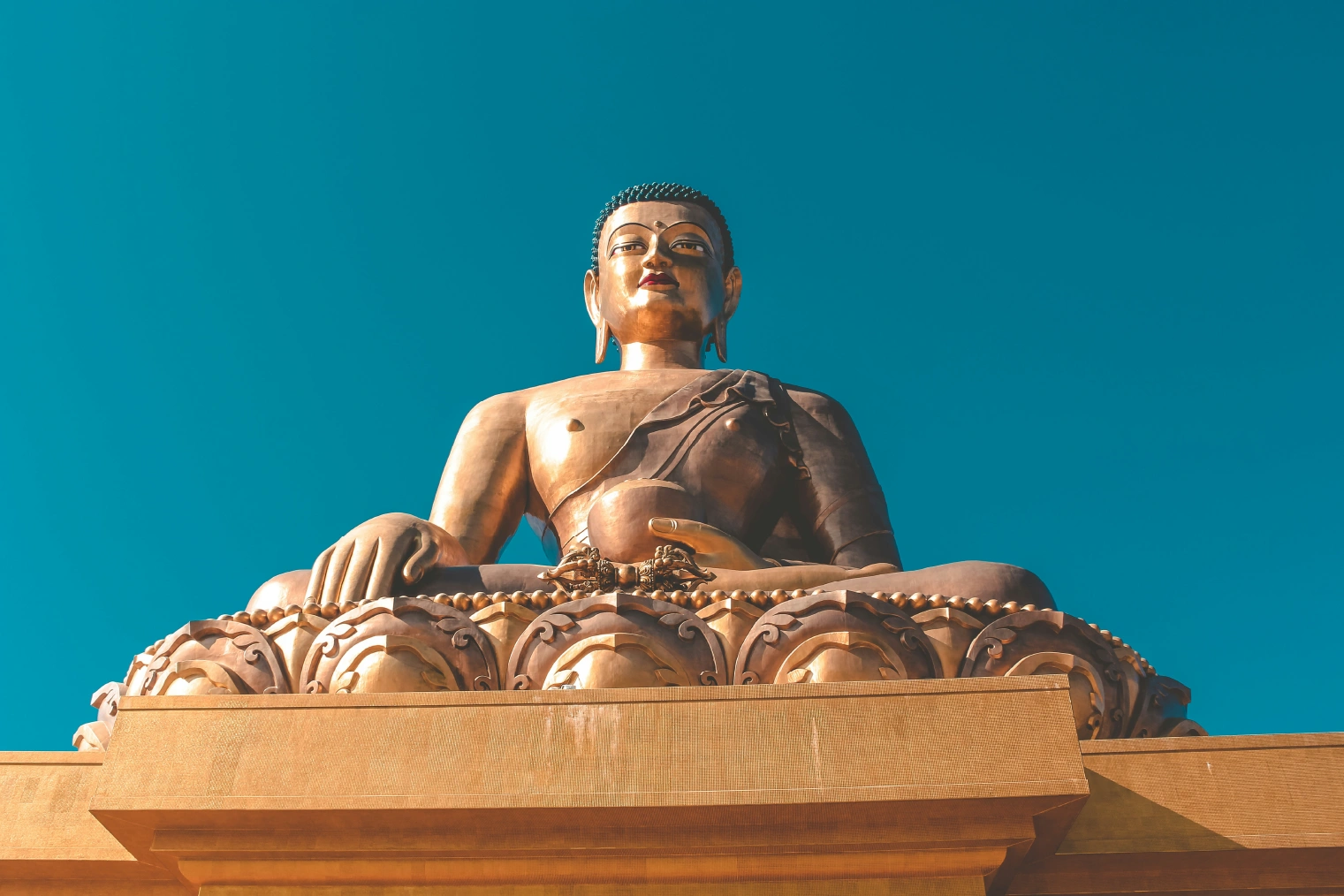
That said, as Buddhists, it’s important to recognize that the Buddha and Guru Rinpoche are not gods, but fully awakened beings. For this reason, you should avoid using the term “god” in formal communications or descriptions when referring to them, as it is factually inaccurate and can lead to confusion.
Ultimately, as previously noted, the true goal of Buddhist practice is not to attain rebirth in a heavenly or god realm — since such states are conditioned and thus impermanent — but to awaken to the truth, just as the Buddha did. Unlike those transient states, awakening is unconditioned and therefore regarded as truly permanent, or more precisely, beyond time.